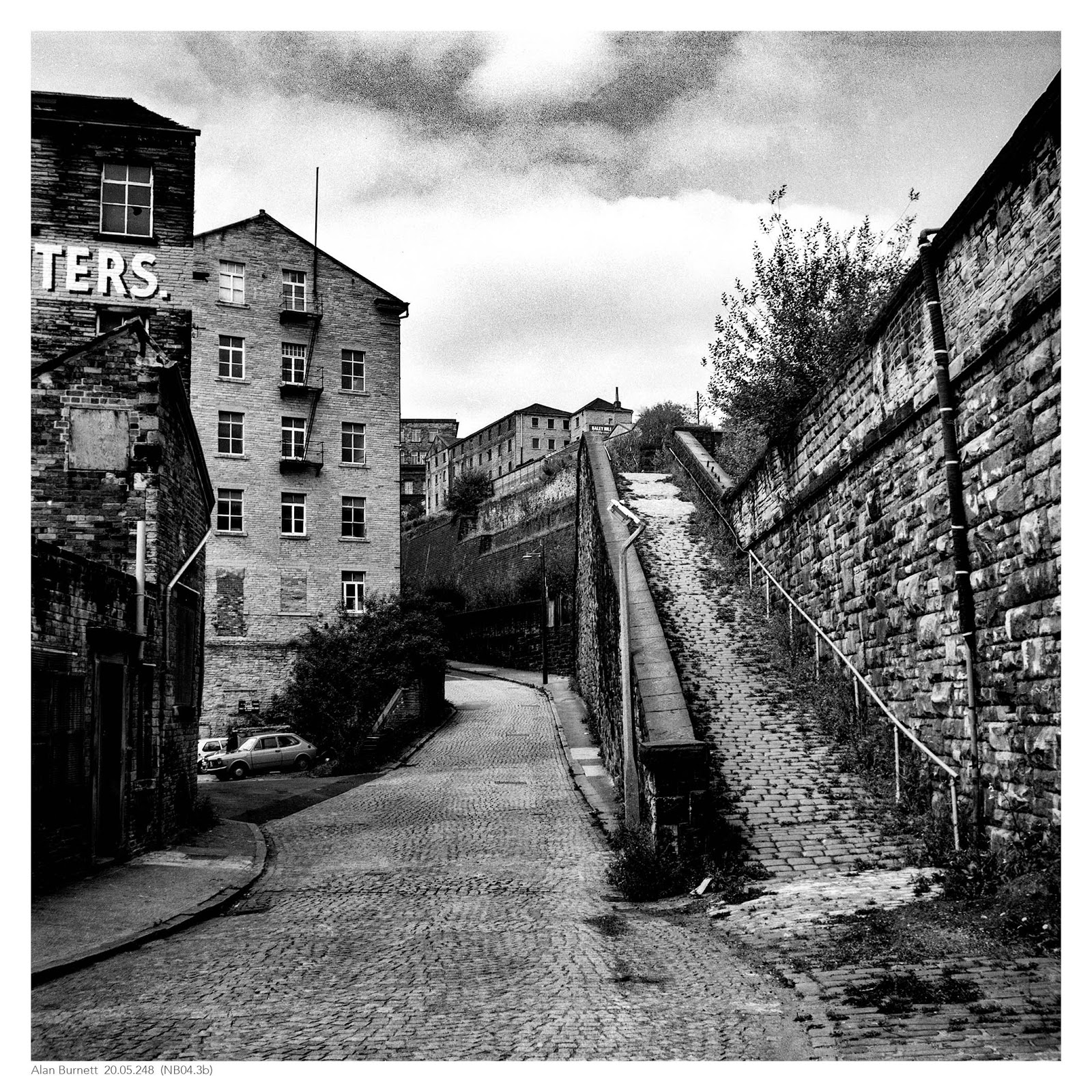
Anyone who has been following the progress of my scans for the last few days will know where I had arrived at by the end of this strip of negatives from the late 1960s. It is Halifax's answer to a triumphal arch: built by the Borough Engineer in 1900 out of stone and cast iron; a monument to the power of hard work and industry. It is the stone steps leading up to Godley Bridge.
Monday, May 25, 2020
Saturday, May 23, 2020
God And Industry
A hundred yards or so after taking yesterday's photograph, I must have turned again towards Halifax and taken this next one in the series. It captures the old railway sidings at North Bridge particularly well, along with Smith's Wire Works. Monuments to both God and industry vie for control of the skyline.
Friday, May 22, 2020
Grand Scenes
This has always been one of my favourite photographs from the late 1960s. I strongly suspect that the back yard I took this from no longer exists: indeed, nor does the house, nor does the street. And the view no longer exists. Gone are the cooling towers, the gasometers, and the chimneys, and all you would see if you stood there today, would be a lot of trees. This is a different Halifax of fifty or so years ago: a little lost, a lot dirtier; but full of grand scenes.
Thursday, May 21, 2020
Venetian Chimneys
Following on from yesterday's virtual day at the seaside, today we are back in Halifax, and where better than down behind Halifax Gas Works. I have always thought there was something vaguely Venetian about Halifax. Canaletto would have felt at home here.
Wednesday, May 20, 2020
Exotic Bridlington
It is easy to get the impression that, during the 1960s and 70s, I did little other than take photographs of rainy days in Halifax. Occasionally, however, I escaped to the sun, and, as I scan my way through my negatives, I will find shots from some exotic location or other. These example are from Bridlington and, I think, date from the mid 1970s. It was a time when boat rides on the Bridlington Queen followed by a game of Bingo (where the prize was a 50 pence food voucher) constituted an exciting day out. It was a time when social distancing referred to the space you would leave between your deck chair and the next one.
Tuesday, May 19, 2020
Stepping Back
Stepping back slightly from yesterday's photograph, this gives a better idea of where the snicket was - and still is. Again, this was taken in the 1980s, a time of transition for this part of Halifax. Old Lane seems to justify its name, the various mills seem to be in search of a new future.
Monday, May 18, 2020
Snicket Revisited
I took this photo 40 years ago. I have taken the same scene many times over the years; and so have many other photographers far better than me. The most famous version is Bill Brandt's 1937 "Snicket In Halifax", which forms part of the collection of the New York Museum of Modern Art. A classic image of a classic town.
![]() |
| Bill Brandt : Snicket in Halifax 1937 |
Wednesday, May 13, 2020
News From Nowhere : 13 May - The Look Of Faded History
SOUNDS FAMILIAR
![]() |
| BRIGHOUSE NEWS : SATURDAY JUNE 26 1880 |
With nothing much to do other than read old newspapers, I found this article in a copy of the local Brighouse News from exactly 140 years ago. It was a report by the Chief Medical Officer, Dr Britton, on efforts being taken to combat the outbreak of scarlet fever (Scarlatina) in the town. Reading through the list of measures – social distancing, quarantining, closing schools, limiting funeral ceremonies, even gratuitous disinfectants – you are suddenly reminded that little is new in this world. Granted, we have yet to see the reintroduction of “Nuisance Inspectors”, but it is probably just a matter of time. All I need to do now is to find a copy of the newspaper from a year later to see whether things will ever return to normal.
CAMELLIA GONE
A high resolution scan of the fallen blossom from the Camellia bush in the back garden. For weeks I have watched the bright pink fading into brown, and now most of the life seems to have gone from it. It leaves, however, a kind of beauty that can rival the boastful loudness of its prime.
MEASURED LOOKS
The wonderful thing about Victorian Carte de Visite portraits is the measured looks of the sitters. No Facebook smiles or Instagram lips, just the hint of a smile. This excellent example was available for 50 pence in an Antiques Centre and originated in the Blackpool studios of H Wiggins.
Tuesday, May 12, 2020
News From Nowhere : 12 May - Flowers, Places & Valleys
FLOWER SCAN #2
The second of my flowers scans features a bloom that was plucked from my garden this morning. I am not sure what the common English name for it is, but I have included the Latin name for all you horticulturalists out there.
I KNOW WHERE THIS IS
I know where this is. It’s familiar. I feel as though I’ve walked down this road, wandered along this canal towpath. In truth, I must have – I took the photograph. It was 35 years ago, and therefore I can be forgiven for forgetting the grid reference or the street name. It left, however, an imprint on my mind; a set of shapes and lines which can be awakened after three and a half decades. I look at the photograph, an alarm goes off somewhere in the distance, and I say to myself – I know where this is.
THE VALLEY IN-BETWEEN
I took this photograph a couple of days ago whilst walking in Greetland. It shows the view across some fields towards Wainhouse Tower and Crossley Heath school in the distance. It’s a lovely sight, as fine a view as you could find anywhere in this land. What you can’t see, however, is what I love most of all about this place I call home. Behind the first set of trees and before the second, there is a valley. Not some piddling little thing, but a monumental valley carved by glaciers many thousands of years ago. A valley with roads, railway lines, rivers and canals. A valley with houses, factories, offices and workshops. A valley with life and love. We hide these things well in these parts.
Wednesday, May 06, 2020
Dark Days And Wet Cobbles
Halifax Piece Hall back in the 1970s and 80s: in transition between low carrots and high culture. Half full stalls and half empty walkways: dark days and wet cobbles. Everything is so much brighter now, the scale is so much grander.
Monday, May 04, 2020
Scan To Survive
What else is there to do during lockdown than visit the past? Therefore, I scan to survive; and the strip of negatives that took the journey across the scanner today included a set of photos shot in a typically West Yorkshire field some fifty years ago.
In the first photograph the field divide is a typically Yorkshire dry stone wall. In the next two shots it is something even more distinctive of the area around Halifax, Elland and Southowram, where stone quarries provided a constant crop of high quality flag stones during the eighteenth and nineteenth century. These great stone slabs were like ancient monoliths, dominating the skyline. Many have vanished over the last half century - they must have quite an intrinsic value in their own right - but a few still remain, although they have been partly lost in the post-industrial growth of trees and shrubs.
Escaping from my lockdown yesterday, for a precious hour in the fresh air, I found this surviving example in a lane about a quarter of a mile from where I live.
Subscribe to:
Posts (Atom)
The Essence Of The Image
I have suitcases full of old photographs - my lost images collection - and sometimes, when I'm sorting through them, one will shout out ...
-
I've no idea who the child is or why the donkey seems to have lost its head, but that doesn't matter. It's just one of the pri...
-
Y ou can spend too long sat inside reading old newspapers and cataloguing old postcards. There comes a time in the affairs of man when he s...