Monday, September 17, 2012

Like A Vicar In A Strip Club

You may recall that I was going on last week about being the type of person who needs to organise the world into neatly labelled file boxes. My excuse for a brain likes to link B to C and then place them in their rightful position between A and D. If George Orwell had been writing about me in 1984, my Room 101 would have been the kind of student house The Lad lived in last year, where cast-off objects littered each room like some ever-palpable dandruff (he seems to have undergone a sea-change this year but that is another story). However, as with many annoyingly organised people, I like to occasionally walk on the dark side. Like a vicar surrepticously entering a strip-club, I like to abandon my ordered faith and see where my fancy takes me. This will be such a week. Who knows where my posts will take me by the time Friday comes around, certainly not me. If you would like to jump on board and join me in this mystery trip, please be my guest.


I am starting at the Butlins Holiday Camp in Skegness, England in 1938. Normally there would be a reason for starting there, but remember, this week we have left rationality in the cloakroom. I know it is Skegness in 1938 because the picture was taken by Uncle Frank and we all know how he loved to catalogue all his photographs ("Frank Fieldhouse, I renounce thee, you shameless organiser") I know it is Bultins because it says so just above Auntie Miriam's head. Now if I was a logical and organised person, I would go on about how the British Holiday Camp movement was started by Sir Billy Butlin when he opened this very camp in Skegness just two years before the photograph was taken. But the dangerous, irrational, unorganised me has no time for such trimmings. Just look at the photograph and let your mind go where you want it to. And call back tomorrow to see where mine has gone to.

Friday, September 14, 2012

Sepia Saturday 143 : English Spoken


Our Sepia Saturday archive image prompt this week features the interior of a busy Australian grocery store in 1944. For a family which comes from a so-called "nation of shopkeepers", shopkeepers are notable by their absence in my ancestral line, and it is to the outside of a shop that I have to go to find a suitable old photograph for Sepia Saturday 143.

It is a photograph of my father (right), mother, and a friend of theirs called Charlie Pitts, and it must have been taken in the mid 1930s. The sign in the window clearly says "English Spoken" and the photograph was taken during a day-trip to Calais in France. I remember my father telling me about the trip many years later. Until we went on a camping holiday to France in the early 1960s, it was the one and only time he had been out of the country. My parents and "Uncle Charlie" would often holiday together on their motorbikes and they have been featured before on my Sepia Saturday submissions. Although my photograph predates the Australian photograph by some ten years, you get the impression that, were you to enter through those sepia doors, there would be the same arrangement of stacked shelves and busy industry.

Move on 30 or so years and the faded sepia gives way to the washed-out colours of a 1960s colour transparency.  This is a photograph taken on that second trip to France and it shows Albert and Gladys sheltering from the sun in their tent on a camp-site at Juan Les Pins in the South of France. I was about 14 at the time and the holiday was a great adventure. After driving through France and sitting in the sun for a couple of days, my poor father had to take to his bed with sunstroke. My mother spent her days, trying to keep insects off the sandwiches and searching for shops with signs saying "English Spoken"

All sorts of languages are spoken by that band of sepia people who each week contribute to the Sepia Saturday Blog. Take a trip to the Sepia Saturday Blog and see what is on offer this week.


Wednesday, September 12, 2012

A Modern Day Cure For Collectivitis

I have always been a keeper, a sorter, a filer, an archiver. It's a personality type characterised by the desire to put things in boxes, stick labels on the boxes, and stack the boxes in some kind of order. Sometimes it's a blessing (I am always the one asked to help find things) and sometimes it's a curse (I am always the one asked to help find things). Throughout my life the filing medium may have changed, but the message has always been the same : "clip it, tag it, and save it". At one stage it was things cut out and stuck onto filing cards, and then when computers came onto the scene, it would be complex databases of trivial information. My music collection has been catalogued more times that a Mozart symphony, my negatives have been archived with a care that would be more in place in the Library of Congress.

However, the day of the stand-alone database has passed, and more recently my base desires have gravitated towards the clouds - or to be precise, cloud cataloguing. Step forward, EVERNOTE. I don't think that I have been as happy with a system since the day I first discovered my first 6" x 4" file card. Evernote is a wonderfully simple piece of software which allows you to clip and save almost everything and share the results between a variety of devices. I use it to save on-line press cuttings, blog-posts, and interesting web-sites. I also use it to index my music collection, reference my photographs, keep my personal diary. and file my paperless collection of gas and electricity bills. Because things are filed on-line, they are protected from the ravages of computer failure or loss. It works on Mac and PC, iPads and other tablets, and even most smartphones. You can set up an account for nothing and this includes enough on-line storage for most needs. If, like me, you suffer from severe collectivitis, you can opt for a premium account for just a few pounds (dollars) a month and set about saving the world.

The point of this post is to celebrate the 1,000th item I have added to my Evernote collection (which will be a clip of this blog-post). And I should stress that this post is a response to having found a very useful piece of free software which I want to share with my friends. It has not been sponsored by, or paid for by Evernote.

Now, where did I file that recipe for Apple Crumble?

Tuesday, September 11, 2012

Detritus And Scandimania (All Rights Reserved)

I took my dinner suit for dry cleaning yesterday. It must be the first time in 10 years it will have been cleaned, and before packing it off I needed to clear out all the pockets of a decades' worth of detritus. In the main, I have to confess, these are bar bills, but each of these little printed dockets is a memory pickled in alcohol. Rather than just throw them away, I decided to scan them, frame them and hang them in my virtual art gallery.

I would have printed the resulting picture and pinned it to my wall, had it not been for the fact that I am making a determined effort to go paperless. My newspaper now arrives via wifi, most of my books are  Kindle-ised, and I spend a little time each day scanning each new gas bill or credit card statement and then shredding the originals into the kind of material that provides bedding for guinea pigs.

Following up my comments yesterday about copyrighting old photos, I thoroughly agree with everything that Christine, Jennyfreckles and others said in their comments. Where people take their own photographs or where they research and explain old images taken by others, they deserve acknowledgement and protection from other people stealing their work. My complaint was with people who merely scan an old image which is out of copyright and then attempt to claim that they have established some kind of copyright over an image they have added no value to. Quite clearly, I have added value to the bar bills and therefore the image above is copyright Alan Burnett, 2012.

Monday, September 10, 2012

Back To Reality After A Trip Along The Niagara River To Fit A Water Meter


No I have not been away again, but I have had a couple of weeks with loads happening and less time than normal to write blog-posts and visit my favourite blogs. I have returned to normality with a trip down the Niagara River on board the steamer "Chippewa", getting off at the town of Lewiston, New York. I am not sure where I acquired the postcard from, I rather think I might have bought it from an antique stall rather than acquired it as part of Fowler Beanland's collection. There is an image of a similar card on the web, but someone has decided to overprint it with copyright information. Well, this is my card and I scanned it and I hereby declare that anyone can reproduce this image without payment, without consultation and without acknowledgement.

I suspect I paid 20p for the card (I rarely pay more), but for that I have acquired a bit of history. I was also sent on a virtual digital tour, checking to discover where Lewiston was, looking to see if the landing stage is still there and to see if the opposite bank of the river is still tree-lined. I have had the pleasure of reading up on the history of the Niagara River Line, and even discovering that the ship name is derived from one of the oldest tribes of Native Americans. That is a lot of pleasure for 20p.

All that water flowing down towards the Niagara Falls reminded me that it was Monday and therefore my regular appointment with the Water Company who, for what seems like years now, have been trying to fit a water meter. A large gang of workers arrived at 8.00am this morning but then proceeded to shake their collective heads and talk about complex excavations through sand-beds (or something similar). They said it would need an even larger gang with specialist equipment: they will be back next week no doubt.

Thursday, September 06, 2012

And So To Digital Bed

On the train down to London on Saturday I was reading Samuel Pepys' Diary and before I could stop myself I found myself thinking, what would it have been like if Samuel Pepys had owned an iPad? Well you can guess where this is going.... As I have been absent from my Blog for far too many days, I thought it would be useful to update you on what had been happening. The notes are downloaded from my iPad diary.


Friday, August 31, 2012

Sepia Saturday 141 : Time Gentlemen Please

The archive picture prompt for Sepia Saturday 141 features a clock. Clocks constantly remind us that time itself is a precious commodity.


I am a little pushed for time this week and for Sepia Saturday I am featuring a number of photographs I took some time (indeed many years) ago and only recently discovered the time to scan. The first picture was taken some thirty years ago and features part of the exterior wall of the Saloon Bar at the Black Friar pub in London.


Around the same time, I took this picture in Elland, West Yorkshire. The smoke and the old cars and the general feeling of abandonment make it a type of visual time-capsule.


This time we are moving a few miles south to Sheffield and maybe a few years forward in time. But it is still the Thatcher years and the same feeling of abandonment.


It was around this time - the early 1980s - that I fell in love with Grimsby Fish Docks. Whenever I got any spare time I would drive over to Grimsby and walk around the lines of smoking houses and fish warehouses trying to capture the smell of dead fish on monochrome emulsion.

And so to the reason why my Sepia Saturday post is somewhat hurried this time around. This weekend I am being taken away on a belated birthday treat, to go on a tour of some of the ancient inns and taverns of the City of London. Hopefully that will include the Saloon Bar of the Black Friar and hopefully I will sit there, replete with fine beer and good company, until the Landlord declares "Time, Gentlemen Please".


Make sure that you get time to visit the Sepia Saturday Blog and see what the other participants are up to this weekend.

Wednesday, August 29, 2012

Out Of The Studio Into The World

I have two photographs today which mark a momentous moment in the history of photography; when it stepped out of the confines of the studio and into the world. Although most of the very earliest permanent photographs were taken out of doors, the new art-science of photography quickly moved into the studio with likenesses of Victorian citizens frozen rigid by the needs of slow shutters and unresponsive film and plates. If you leaf through a pile of Carte de visites, you are struck by the way the individuality of the recorded faces seem to have been leached out of the image until you are left with little else than matronly woman or bearded man. It is almost as if the context of the photograph has been faded in the same way that the background merges into white space.

The CdV of an unknown woman is by the studio of F Bentley of Halifax. I can't seem to find a listing for the studio or when it was active, but at a guess the photograph will have been taken in the last couple of decades of the nineteenth century. I am not sure what can be said about the woman, other than the fact that it almost looks as though her face has been stuck on top of a different pair of shoulders. Was she happy or sad, rich or poor, moody or flighty - who knows.

My second photograph must have been taken at about the same time. Although there is a slight resemblance to the woman in the first photograph, the only relationship I know of was that their CdV photographs were in the same 50p bargain tray in an antique centre 120 years after they were taken. But we have left the studio behind and entered the real world and we are now bombarded by context and peripheral information. The row of houses with their high stone chimneys suggest that the photograph was taken in West Yorkshire and tell us something about the life of the woman and child.

Even the odd little detail is fascinating. Look carefully and you can see a couple of sheets of corrugated galvanised iron on what seems like a lean-to shed. Intrigued I checked out when corrugated galvanised iron was first introduced and I discovered that it was invented by Henry Palmer, architect and engineer to the London Dock Company, in the 1820s. Which was almost exactly the same moment in history that Nicéphore Niépce was taking that first photograph. 

Now there's synchronicity for you.

Saturday, August 25, 2012

Sepia Saturday 140 : Sepia Reflections

OK, I admit it, I cheated. Wanting a way to try and remember my wedding anniversary and selecting the archive theme image for Sepia Saturday provided a marvelous synchronicity. So for Sepia Saturday 140 which falls on Saturday 25th August 2012, I chose a wedding picture and my own contribution features three pictures taken at my own wedding, 39 years ago today. 


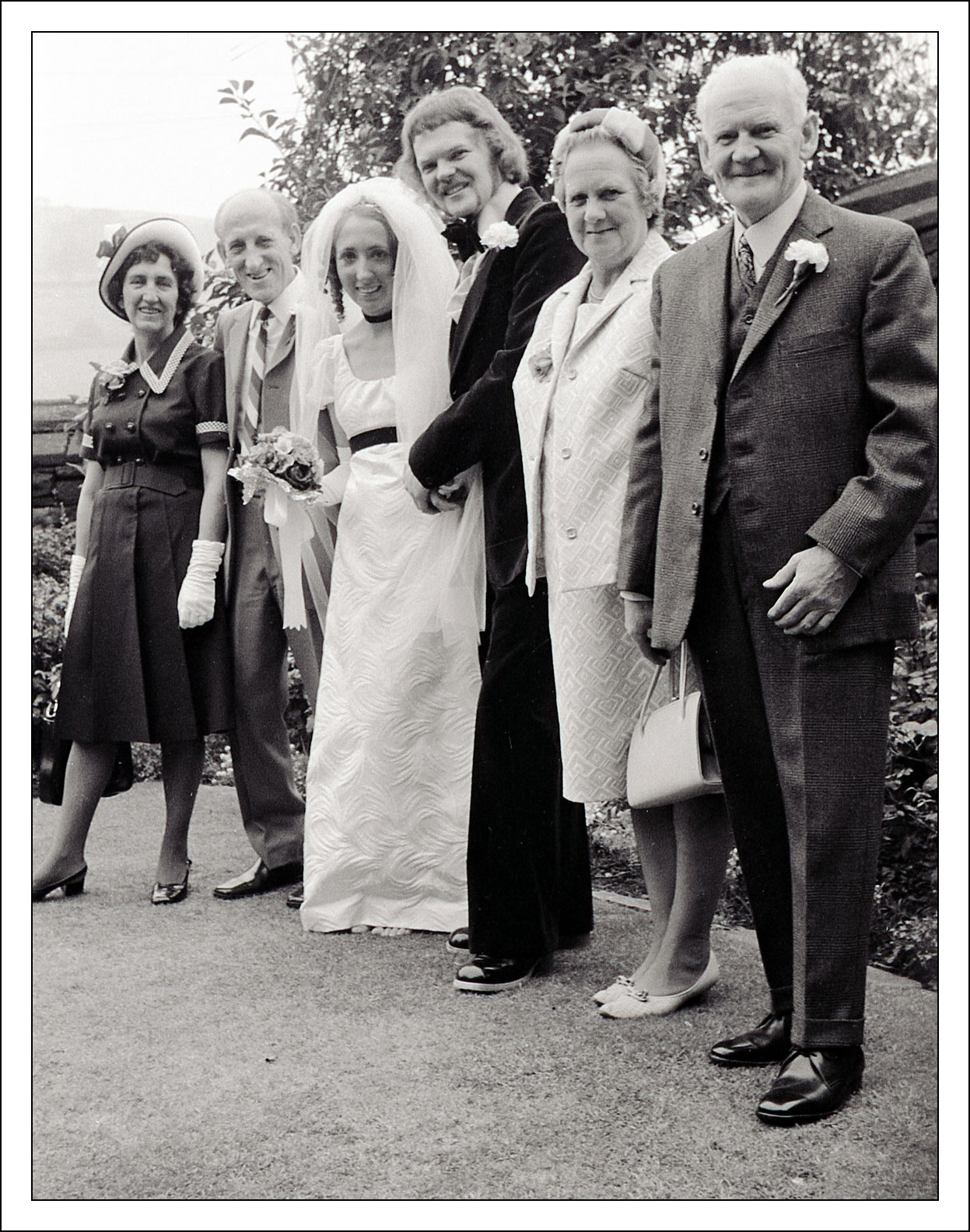
The first photograph shows me clinging on to Isobel for dear life, confetti falling around us like some over-sized dandruff, as we leave Halifax Registrars' Office on that Saturday afternoon 39 years ago. That is not a ferret around my neck, but a somewhat flamboyant velvet bow-tie.


With our four bridesmaids : Di, Julie, Caroline and Jane. We are still in regular contact with all four : Jane and her husband will be staying with us for the weekend in a couple of weeks time, and in October we are visiting Di and meeting her first grandchild!


With our parents - Edith and Raymond on the left and Gladys and Albert on the right - all sadly now departed. In case you are wondering where my brother is in all these photographs, he was behind the camera : we have never been much for wasting good money on photographers in our family.

The photographs are not exactly sepia but at 39 years of age they qualify for inclusion in Sepia Saturday. And the "tag line" for Sepia Saturday is "using old images as prompts for new reflections" and the very act of scanning and publishing these three images has brought forth a whole corsage of reflections on 39 happy and wonderful years. Happy anniversary my sweet.

You are invited to a wedding reception over at the Sepia Saturday website. Come on over, help yourself to a slice of cake and follow all the links to the other Sepia Saturday posts.

Wednesday, August 22, 2012

Gits, Ships And Cuts

FOREVER GITS
We have a meeting of the Old Gits Luncheon Club today and our two main objectives are to sample as many real ales as we can in the time available and to reach agreement with regard to the long-running dispute about our name. The main proposals on the table are:
- The Gentlemen of Refined and Independent Temperament Luncheon Club (GRITS)
- The Gentlemen of Independent Temperament Luncheon Club (GITS)
- The Gentlemen of Refined and Independent Means Luncheon Club (GRIMS)
Personally I would be happy to leave it at the Old Gits, especially as I have just designed a new T-shirt. I will be wearing it for the meeting later today. Hopefully it will swing the vote.

WIKIMEDIA
I have decided to become a member of Wikimedia UK. This has nothing to do with any Ecuadorian asylum seekers - it is just that in an age when the commercial ownership of ideas and images seems to have accelerated beyond control, any movement that exist "to help collect, develop and distribute freely licensed knowledge (and other educational, cultural and historic material)", is worthy of support. Just what my membership will entail, I have yet to discover, but as long as it doesn't mean living in the Ecuadorian Embassy for the rest of my days, I am willing to give it a try.

EXCAVATING WORDS
At long last I have returned to the Great Novella of the 21st Century (GN21) after allowing it to lie fallow for the last five months. Starting up again is hard work: it's like digging potatoes from a parched vegetable patch. I spent an hour this morning churning out Kindle-drivel, before editing out the rubbish. This leaves me with just two sentences!

“And did he do it?”, Tomlinson asked in a tone measured to the point of precision.
“Who knows, who cares? He has certainly confessed to doing it, but there is no surprise in that. People will confess to anything if they are given enough encouragement”.


The conversation takes place on a ship. The picture of the ships comes from Wikimedia. Everything connects. It's time to go to the Old Gits now.


Standing On The Edge

It seems so long ago - almost another age. The colours and styles may have changed, but then, as now, we stood on the edge and looked out.