Saturday, February 07, 2015

Sepia Saturday 265 : Don't Forget To Bring Betty


Our Sepia Saturday theme this week is all about pots, paints, classrooms and artistic young ladies. So let me introduce you to Miss Delia Mason, the celebrity pin-up girl of the Edwardian era and star of that box office hit, "Three Little Maids". And our photograph features Delia posing with a full set of cups and pots and although she is not actually painting them she can be forgiven: she is, after all, a celebrity. I checked out the show "Three Little Maids" and it is described as the story of "three simple curate's daughters who go to London to earn their livings serving tea in a Bond Street tea shop. They become the romantic rivals of three ladies of fashion but succeed because of their freshness".  Whilst such a story in itself is probably enough to make you rush out and book a seat in the stalls, an additional incentive is the inclusion of a song at the end of Act 1 with the title "Golf is an excellent game in its way – But ev'rything's all 'in the way."


The message on the back of the post card, as always, contains more questions than answers, but that is the delight of old postcards (can there be a finer stimulus to the imagination than such short messages scribbled on the back of postcards?) It is the upside down appeal at the very top of the postcard which remains in my mind as I try to find sleep at night. "Don't forget To Bring Betty"

And if you are going to bring Betty, why not bring her to see the other Sepia Saturday posts this week by visiting the Sepia Saturday Blog.

Friday, February 06, 2015

Henry Tanner And The Coping Stones That Could Cope With Anything


You can walk past a building 100 times and never notice it. In fact I have probably walked past Halifax Post Office 5,000 times and never really noticed it as a building. I have been in it, on occasions I have even worked in it, and never really noticed it. But I did the other day and I realised that it is a Camelot Castle of a Post Office. It has little towers and cupolas, bulls eye windows and coping stones that could cope with anything.

It was designed by the architect Henry Tanner whilst he was serving as Surveyor at the Leeds Office of Public Works and opened in 1887. A contemporary newspaper report says that it "is a spacious building and has capital frontages to Commercial Street and Old Cock Yard". The cost of the building was £10,000, exclusive of the cost of the site.

When I was younger I worked on the Christmas post and would heave my heavy post bag each morning out of the sorting office around the back of the building and off to catch the bus to take me to my round.

Henry Tanner did not stay in Leeds for long. By the time the new Halifax Post Office was opened, he had returned to London and he want on to design many famous public buildings. He was knighted in 1904 and lived until 1935 when he dropped dead walking through his own front door one day at the age of 88.

His obituaries were sadly brief and concentrated on such things as his Chairmanship of the Royal Sanitary Institute and his Presidency of the Concrete Institute. Fine as these eminent positions may have been, I prefer to think of him as the man who designed the post office I have now started noticing.

Thursday, February 05, 2015

A Dozen Dollops Of History : 5 - The Last Of The Summer Of The Last Of The Summers

My fifth found dollop of history (50 pence from the second hand shop) features a 1913 vintage postcard of Lantern Hill, Ilfracombe.


This is another card which is a bit difficult to read, but as far as I can make out, it goes like this:

Dear S, Many thanks for letter, sorry I forgot to mention about the parcel, thank you so much, of course I am busy out hoppicking now it's got hotter, will write you next week and tell you all news. We have only another fortnight here. Kind love from us all, Yours Beat  And On The Front : Was pleased to hear you had a nice time. I really did not expect you to come down here, it is just the same old slog.

The card was posted in Malvern in Worcestershire, which is not a part of the country I immediately associate with hop picking (one always thinks of the hop fields of Kent), but a quick check online reveals that it used to be quite a centre for hop growing and there is a rich heritage of hop picking in the locality (Bromyard, which is not far away from Malvern, hosts an annual hop festival and the world hop pocket championships!). Miss Lawrence was Miss Sarah Lawrence, who, when she received the card, was a 37 year old parlour maid at the house of Frank Marsh a Consulting Surgeon at the United Hospitals of Birmingham. Marsh was to become a Lieutenant-Colonel in the Royal Army Medical Corp Reserve and serve at the Army's 1st Southern General Hospital in Birmingham. 
I can't look at the card without looking at the date: September 1913. It is the last of the summer of the last of the summers before war descended. The time when hop picking was about to be replaced by trench digging.


Wednesday, February 04, 2015

Shoes, Slippers, Boots and Gaiters And A Sense Of Belonging


I was having a lunchtime pint with a mate of mine yesterday and the conversation came around to the idea of a sense of belonging. We are both from these parts and we agreed that we would have difficulty in moving away. I was saying that, for me, that sense of belonging was not just with people and that diverse diorama we call culture, but with the physical built environment. Step through almost every door and there is my family, lift every grave stone and there is my history.

So let us take a gravestone at random and tease out the story, for below every gravestone lies a story far more powerful and resonant than any pile of decaying bones.  The following gravestone can be found in the churchyard of St Martin's Parish Church in Brighouse. When I took the photograph last week, I had no idea who Lydia and George Mitchell were. They are neither part of my extended family nor possessing of any particular fame and fortune. But they are part of the shared history and the shared environment that I belong to.

This is one of those exercises that would have been too troublesome and too difficult before the dawn of the digital age. But now we can access family records, census information, books and newspapers with ease. So all we need to do is to press a few computer keys and George and Lydia begin to come back to life.

George was born in 1801 in Kirkheaton, a few miles south of Brighouse where he later was to settle, marry and bring up his family. On the census records of 1851 and 1861 he is listed as being either a cord maker or a cordwainer. A cordwainer is the old name for a boot and shoe maker. He lived on Commercial Street in Brighouse and his two sons, William and George were also listed as being cordwainers. As we can see, George eventually died in 1877, but by then his children had taken over the business, and Mitchells continued to be the main shoe and boot maker in Brighouse well into the twentieth century. The following description of the business is taken from W.T Pike's 1895 book "An Illustrated Account of Halifax, Brighouse and District" and relates to the time when the business was under the control of George's son, who was also called George.


Mr George Mitchell, Boot and Shoe Maker, 30 Commercial Street, Brighouse.
An old established connection in the boot and shoe trade of Brighouse is held by Mr George Mitchell, whose business was commenced about forty-five years ago some four doors from the present site, which was then occupied by his brother, William Mitchell. On the latter leaver these premises after twelve years residence, Mr George Mitchell removed to them. At that time they were two small shops with dwelling houses, which he afterwards, as a consequence of the growth of the trade, converted into one large business establishment, transferring his residence to South View, Clifton, some little distance from the town. This enabled him to devote the whole of these convenient premises to the purposes of his trade. Their capacity may be noted from the following brief description. There is a large workshop in the basement, the ground floor comprising a substantial and well appointed shop with plate glass windows and large fitting and stock rooms at the rear. On the upper floors, nine rooms in all are fully occupied as store rooms etc. The situation is admirably adapted to the trade, and during the thirty years of Mr Mitchell’s occupation, it has become the accredited centre of this particular trade, with a good general family and better class connection. He keeps in stock leading lines of special gentlemen’s, ladies’, and children’s boots and shoes. As a hand sewn bootmaker, he has the largest trade in the town, and is noted for first class repairing. The bulk of the goods are kept in boxes on neatly arranged shelves, both in the front shop and stock rooms. There is a very large stock of children’s shoes, slippers, boots and gaiters, selected from the very best makers. All the minor goods of the trade are stocked, and hand sewn boots are an important branch. The windows form a very suitable index to the stock, enhanced by very tasteful arrangement. The shop is lit with electric light, it is almost opposite the General Post Office, and has a very fine appearance. The large lamp and signboard, with gilt lettered windows, demoting the name and trade. The staff of hands employed varies according to the requirements of the seasons, but Mr Mitchell has gradually increased his business since its commencement thirty five years ago.


I can half imagine my great-grandfather entering the shop and perusing those neatly arranged shelves of boots, shoes and accessories. I can almost imagine my Great Uncle Israel Burnett, who was a butcher, chatting with George Mitchell and speculating about trade. My grandfather Enoch may have cleaned those plate glass windows. That is belonging.

Monday, February 02, 2015

A Dozen Dollops Of History : 4 - It's Our Ernest Again

My fourth found dollop of history (50 pence from the second hand shop) features a 1908 vintage postcard of Pimpernel Cross and Church.


Here we have another card addressed to Mr Saunders of Taunton (see Dollop No. 3). The handwriting is difficult to interpret in places, but based on the existing evidence I think we can conclude that it is the same Ernest Saunders of Kingston St Mary, a few miles north of Taunton in Somerset. I tried another search for Captain Saunders (at least we know he was a Captain in the Somerset Light Infantry by the following Christmas) but it turns out that, according to Google, the acknowledged expert in the field is the chap that writes the News From Nowhere Blog.

It is another Christmas card, this time from someone whose name defies even my powers of interpretation, but I think we can conclude that the daughter referred to in the last card is the same Dorothy mentioned in this card. By now I feel that I know Ernest quite well - in my own sweet if rather eccentric way I refer to him as "our Ernest" - but just how his collection of old postcards migrated from rural Somerset to an Antique Centre in Mytholmroyd, is still beyond me. Perhaps amongst the remaining eight cards I will discover another addressed to our Ernest (I purposely haven't peeped ahead to see what else is there, at my age I need all the excitement I can get) so who knows what awaits us in the next dollop around the corner.


Sunday, February 01, 2015

The Inconsequential Love Child Of A Man With Nothing Better To Do And An Apple

It is a cold and icy weekend, so with nothing better to do, I decided to publish a magazine. Say hello to "News From Nowhere Monthly", the somewhat inconsequential love-child of a man with nothing better to do and an Apple.  For many years I have been a great admirer of those wonderful Victorian weekly and monthly magazines that surfed on the wave of working class literacy and brought their readers everything from recipes to travel writing, popular science to part-works of fiction. Bound volumes of The Penny Magazine, The Cornhill Magazine, and The People's Friend can still be found on the top shelves of second hand book shops and, in exchange for a few pounds, can provide endless fascination to the twenty-first century reader. Strange as it may seem, what such popular magazines were, was in fact blogs - blogs that were a  hundred and thirty years ahead of their time. So why not turn the process the other way around and convert a twenty-first century blog into a Victorian popular magazine.

So I have gathered together the January 2015 content from my three main blogs - News From Nowhere, Picture Post, and Great Yorkshire Pubs - added one or two other things just for the fun of it, and published it as a magazine. What you end up with is a cross between blogging and traditional magazines - magging.  The January 2015 issue of the magazine contains, as a special feature, the first chapter of my great unpublished novel of the twenty-first century, Double Crossing (a somewhat lightweight thriller set in 1934). One consequence of this initiative is that, if the monthly magazine continues (and that is by no means certain), I will be forced to set about finishing the book before too long.

The magazine is currently available in grown-up published form and in PDF format, although I have still not worked out how to deliver the PDF files to the wider world. Equally, it would be rather nice if it was downloadable as an e-Book, but that also needs further technical research (especially as it is image-heavy). The published magazine comes in at £6 a copy - from Lulu, there is a link on the sidebar - but this seems a little on the pricey side of things. I will continue to work on ways of making it available digitally and free of charge and report back if I make a breakthrough.

But, there again, the sun might come out and the ice might melt and the pub might open ..... and the January 2015 issue of the News From Nowhere Magazine might be the only issue ever produced.

UPDATE : I think I may have discovered a way of making the PDF file of the January issue of News From Nowhere Magazine available. CLICK HERE to try it.

Saturday, January 31, 2015

Sepia Saturday 264 : North-East To Tonsberg.


Our Sepia Saturday theme this week features an old photograph which looks down on the port of Tonsberg in Norway, and for some reason the mixture of land and sea, inlets and islands, reminded me of that part of England known as the Norfolk Broads. And therefore I turned to one of the old photograph albums kept by the inimitable Frank Fieldhouse ("Uncle Frank").


YARMOUTH HOLIDAY
JULY - AUG 1949
"We went to "Broadland" - Here and There
These snaps remind us where"


The page that particularly interested me was the one headed Wroxham Broads, which contains two photographs: "Downwards" (which just happens to be one of the suggested themes this week) and "Boating and Yacht Station". Wroxham is sometimes called "the capital of the broads", and, as far as I can tell, the scene depicted in the featured photograph has changed little over the last sixty five years. For reasons I am not quite sure of, I have never been to the Norfolk Broads although I seem to have set off on a journey there on a number of occasions and got waylaid by a country pub. One day, maybe, I will get to stand on Wroxham Bridge and look downwards. And if I decided to get in one of those little boats and sail down that broad to the open sea and then keep on going in a north-easterly direction, my next landfall would be ..... yes, you guessed it, Tonsberg in Norway.

If you decide to undertake such a journey, you could occupy yourself during the long sea voyage by going over to the SEPIA SATURDAY BLOG and following all the various links.

Friday, January 30, 2015

The Brighouse Rock Candy Mountain


Went for a walk around Brighouse this morning in the winter sunshine. I eventually found the Brandy Snap Works (see A MISSION TO SNAP THE DESIGNER BRANDY) which looks everything a Brandy Snap works should look like. Just around the corner were the lemonade springs but sadly the cigarette trees have been uprooted. It's a wonderful place, Brighouse.

Thursday, January 29, 2015

A Dozen Dollops Of History : 3 - In Awe Of A Captain and a Castle


My third found dollop of history (50 pence from the second hand shop) features a 1909 vintage postcard of Kilchurn Castle in Scotland.

Kilchurn Castle is a ruined structure which is either on the banks of Loch Awe in Scotland or on a small island in the middle of Loch Awe (depending whether it has been raining or not). When I saw the card I thought it might be vaguely familiar and I suspect I have seen it from the train when I have been travelling to Fort William on the wonderful West Highland Line. Part of it dates from 15th Century and part of it from the 17th Century, but both bits suffered badly when the castle was struck by lightening in 1760 and it has been abandoned ever since.

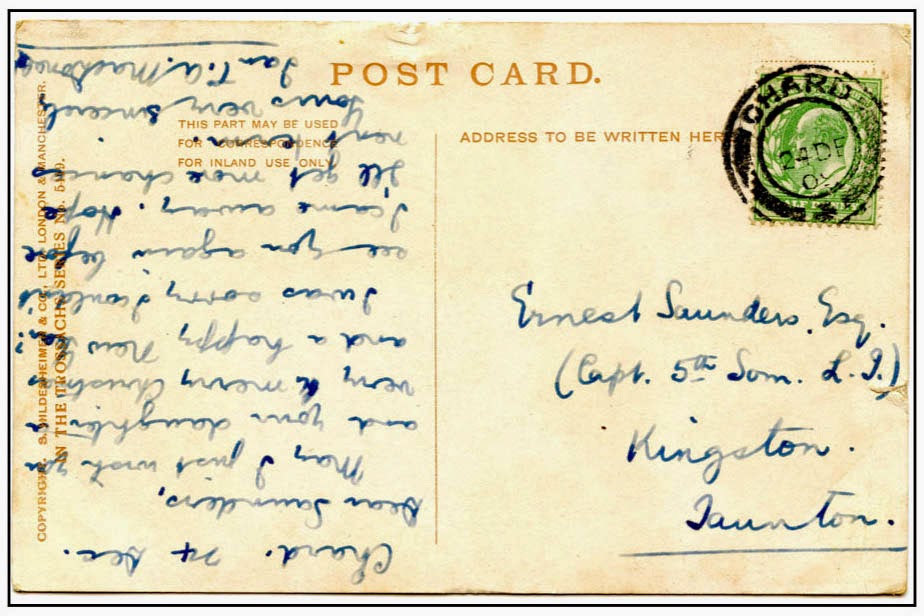
The card was sent to Ernest Saunders, who was a Captain in the 5th Somerset Light Infantry, and who lived at Kingston near Taunton. For some reason, the sender, Ian MacDonald, wrote the message upside down. To save you the bother of standing on your head, here is a transcription.

Chard, 24 December. Dear Saunders, May I just wish you and your daughter a very merry Christmas and a happy New Year. I am sorry I couldn't see you again before I came away. Hope I'll get more chance next term.

If Saunders has a daughter he can't be a pupil and, if MacDonald calls him "Saunders", neither can he. Thus, we can probably conclude that they were both teachers. The card was sent from Chard in Somerset, but I can't find any notable schools there, so we can probably assume that both men had travelled home for the Christmas holidays.

Who knows when MacDonald acquired the postcard. But a postcard of a ruined castle that belonged to the Campbell Clan will always be an attractive prospect to any MacDonald worth his salt.


Tuesday, January 27, 2015

A Cheap Tablet And A Lasting Pleasure


I took delivery of a ridiculously cheap tablet today, it cost under £40 and is just the kind of thing to keep in your pocket and not worry about it getting scratched or knocked. At the same time it can handle my mail, host my Evernote account, access my Kindle library and do most of things that my iPad - which cost me more than 15 times as much - can do. I even discovered that it can even take photographs (of a type) although it is more pin-hole quality than HD. It will join a phalanx of other gadgets I take and access images with.


I took this photograph on my mobile phone last night. A night shot taken on Brighouse Ring Road.


This is a photograph taken over thirty years ago at Orgreave near Sheffield (the site a few months later of the infamous Battle of Orgreave) using one of those old fashioned cameras that used film. This is a recent scan from my negative archives.


And this final example is a picture taken in Venice in October, using one of the latest Digital SLR cameras.  At the end of the day, it doesn't matter how you take them : photographs are a lasting pleasure.


Monday, January 26, 2015

A Dozen Dollops Of History : 2 Auntie Sally Comes Out At Manchester Town Hall

Continuing my tour through the dozen old vintage post cards I bought the other day, searching for bits of history .....


This is a 1922 post card which was sent to Miss Bagnall who lived on Monkton Street in Ryde on the Isle of Wight. We are not sure who sent it, and it is unclear whether the "6" that heads the message is the date or a sequence number. The message is as follows:

I was very glad indeed to hear that Auntie Sally was better and you must tell her I hope she'll go on improving so as to come out

The card was posted in Manchester and the illustration shows the truly magnificent Manchester Town Hall. Built in the 1870s in Victorian gothic revival style and designed by Alfred Waterhouse (who also designed another of my favourite building, the Natural History Museum in London), the town hall is still a wonderful sight in Manchester. The monument that can be seen in front of the Town Hall is the Albert Memorial, one of hundreds of such memorials that were constructed in a wave of Victorian patriotic grovelling following the death of the Prince Regent. Last time that I was in Manchester, that wide open square in front of the town hall was full of wooden stalls selling all many of products, part of the annual German market. Auntie Sally might have enjoyed it, but Prince Albert and his wife would probably not have been amused.


Road As Art

  I am of the opinion that you should never let a month go by without including at least one photograph of Burdock Way in Halifax. This maje...